PowerPoint Tiếng Anh 10 Unit 7: Speaking
Giáo án Tiếng Anh 10 Global Success (Word + PPT)
Lớp:
Lớp 10
Môn:
Tiếng Anh
Dạng tài liệu:
Giáo án PowerPoint
Bộ sách:
Global Success
Giáo án PowerPoint Tiếng Anh 10 Unit 7: Speaking được thiết kế hiện đại, tích hợp hình ảnh, hiệu ứng trình chiếu đẹp mắt với nhiều bài tập ôn tập, mở rộng kiến thức phong phú khi học Unit 7 Viet Nam And Internatioanl Organisations.
Mẫu PowerPoint Tiếng Anh 10 Unit 7: Speaking được biên soạn dưới dạng file Word + PPT tích hợp video AI chào mừng năm học mới chèn vào PowerPoint bám sát nội dung trong sách giáo khoa Global Success. Qua giáo án Tiếng Anh 10 Global Success Unit 7 Speaking giúp giáo viên tiết kiệm thời gian soạn giáo án, dễ dàng chỉnh sửa để có bài giảng hay, lôi cuốn người học. Vậy sau đây là trọn bộ giáo án PowerPoint Tiếng Anh 10 Unit 7 Speaking, mời các bạn tải tại đây.
Giáo án Tiếng Anh 10 Unit 7: Speaking
PowerPoint Tiếng Anh 10 Unit 7: Speaking

Giáo án Tiếng Anh 10 Unit 7 Speaking
Unit 7: VIET NAM AND INTERNATIONAL ORGANISATIONS
Lesson: Speaking
Programmes for communities
I. OBJECTIVES: By the end of the lesson, students will be able to:
- Understand how to express opinions;
- Discuss and express opinions about a project or a programme that can benefit their local area.
- Understand more about programmes for communities;
II. LANGUAGE KNOWLEDGE:
Pronunciation: Word stress …, sentence stress and intonation.
III. INSTRUCTIONAL RESOURCES:
- Grade 10 textbook, Unit 7 - Speaking
- Computer connected to the Internet
- Projector/ TV/ pictures and cards
- sachmem.vn
IV. PROCEDURES:
|
Teacher’s and Students’ activities |
Contents |
|
1. Activity 1: Matching (5’) QUIZ: INTRO TO CHILD RIGHTS - T lets Ss do a small quiz about child rights. Link: https://create.kahoot.it/pages/32c22a99-b815-4a16-8bf1-ec2915c82986?_=1571351723 - Ss do the quiz individually for up to 4 minutes. If there is no Internet connection, T prints out the quiz questions beforehand. - Ss discuss their results and whether they found something new about child rights, as well as what can be done to help children. - T introduces the topic of the lesson.
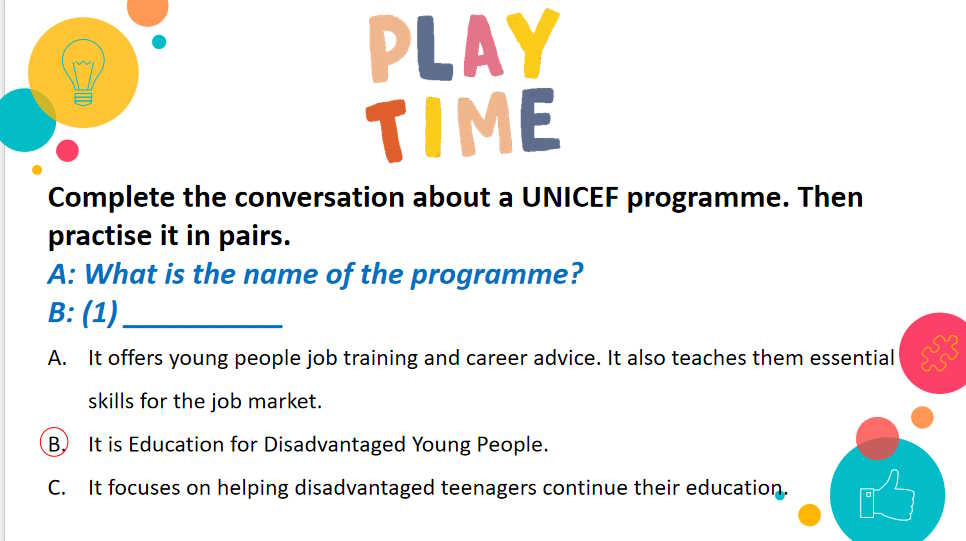
2. Activity 2: (5’) TASK 1: COMPLETE THE CONVERSATION ABOUT A UNICEF PROGRAMME WITH THE SENTENCES IN THE BOX. THEN PRACTISE IT IN PAIRS. (p.80) - T asks Ss what they have learnt so far about international organisations, and their programmes or projects in Viet Nam. T encourages Ss to name the programmes that they have learnt about in the Reading lesson. - T goes through the questions and answers to check understanding. - Ss work individually to match them. - T asks one student to read the question and another the correct answer. - T confirms the answer and has Ss practise the conversation in pairs.
3. Activity 3: (10’) TASK 2: WORK IN PAIRS. STUDENT A LOOKS AT THE TABLE BELOW. STUDENT B LOOKS AT THE TABLE ON PAGE 85. ASK EACH OTHER THE QUESTIONS IN 1 TO COMPLETE YOUR TABLE. (p.80) * T asks Ss to look at the instructions and makes sure they understand this is an information gap activity. T demonstrates using the example exchange about the first piece of information. - T puts Ss in pairs and each student gets a role (A or B) to complete their table by asking each other questions. T gives Ss some time to prepare the questions for their partners. T reminds Ss B to look at their tables on page 85. - Ss work in pairs to do their conversations and complete the missing information in their table without looking at their partner’s table. - T invites several pairs to role-play their conversations in front of the class, then have them read the information in their tables. - T confirms the answer.
4. Activity 4: (10’) TASK 3: WORK IN GROUPS. DISCUSS AND DECIDE WHICH PROGRAMME OR PROJECT IN TASK 1 AND 2 WILL BRING MORE BENEFITS TO PEOPLE IN YOUR LOCAL AREA. THEN SHARE YOUR IDEAS WITH THE WHOLE CLASS. (p.81) Debate: - T asks Ss to read the instructions and the example discussion to make sure they understand what to do. - T introduces some useful expressions for Ss to use in their speaking. - T asks Ss to think about the programme or project in task 2, and discuss in groups to decide which one will benefit their local area more. - T puts some students who have chosen the UNICEF programme into one team and some students choosing the UNDP project into another team. The two teams debate which one is better for their local area, and the rest of the class vote for the most convincing team. - Ss have five minutes to prepare their arguments and assign roles to team members, e.g. who to open and close the debate, when to speak and what arguments to present. - If time allows, T calls two other groups to debate in front of the class. - T asks the class for feedback, then gives comments.
5. Activity 5: Presenting the conversation in front of the class (10’) - Have 1 or 2 groups to present their conversations in front of the class. - Ask Ss to give comments, using the following criteria: The ideas, Voc, Gram, Pron, Fluency,.. - Give feedback to the class.
6. Activity 6: WRAP-UP (4’) - Ask SS: + What have you learnt today? + What can you do now?
7. HOMEWORK (1’) - Workbook exercises - Prepare for the Listening part. |
Key: 1. b 2. c 3. a
Suggested answers: Conversation 1: Student A: What is the name of the UNDP project? Student B: It’s called Poverty Reduction. Student A: What does it focus on? Student B: It focuses on reducing poverty and developing economy in disadvantaged areas. Student A: What are the activities of this project? Student B: It aims to provide technical support and helps develop solutions to local issues. Conversation 2: Student B: What is the name of the UNICEF programme? Student A: It’s called Vaccines for Children. Student B: What does it focus on? Student A: It focuses on protecting children with life-saving vaccines. Student B: What are the activities of this programme? Student A: Its activities include educating people about the benefits of vaccines and vaccinating as many children as possible.
Useful expressions: I think/ believe that the project/ programme … is more important/ necessary for my local area because … This project/ programme helps local people … / brings local people more opportunities to … In our groups, most of us agree that … But one member thinks that … Suggested answers B: Well, I think Education for Disadvantaged Young People will be a very useful programme for our village. You see, many teenagers here drop out of school and start working to earn a living. They really need help. A: You’re right, B.
Suggested answers A: Now, let’s decide which programme or project will bring more benefits to people in our village. B, what do you think? B: Well, I think Vaccines for Children will be a very useful programme for our village. You see, each family in our area has at least 2 children and not all parents are educated about the benefits of vaccines. They really need help. A: You’re right, B.
- Take notes |
...........
Xem đầy đủ nội dung giáo án Tiếng Anh 10 Unit 7 trong file tải về
-
Chia sẻ:
 Trịnh Thị Thanh
- Ngày:
PowerPoint Tiếng Anh 10 Unit 7: Speaking
PowerPoint Tiếng Anh 10 Unit 7: Speaking
9,3 MB 15/01/2026 5:21:00 CH-
Giáo án Tiếng Anh 10 Unit 7: Speaking
Nhiều người quan tâm
Xác thực tài khoản!
Theo Nghị định 147/2024/ND-CP, bạn cần xác thực tài khoản trước khi sử dụng tính năng này. Chúng tôi sẽ gửi mã xác thực qua SMS hoặc Zalo tới số điện thoại mà bạn nhập dưới đây:
Số điện thoại chưa đúng định dạng!
0 Bình luận
Sắp xếp theo

Xóa
Đăng nhập để Gửi
Đóng
Chỉ thành viên Hoatieu Pro tải được nội dung này!
Hoatieu Pro - Tải nhanh, website không quảng cáo!
Tìm hiểu thêm
Mua Hoatieu Pro 99.000đ
Bạn đã mua gói? Đăng nhập ngay!

Bài viết hay Giáo án lớp 10
-
PowerPoint Ngữ Văn 10 Bài 8: Giang
-
PowerPoint GDKT&PL 10 Bài 5: Ngân sách nhà nước tích hợp AI
-
PowerPoint Toán 10 Bài 10: Vectơ trong mặt phẳng tọa độ
-
PowerPoint Tiếng Anh 10 Unit 1: Communication and Culture
-
PowerPoint Địa lí 10 Bài 22: Cơ cấu kinh tế tổng sản phẩm trong nước và tổng thu nhập quốc gia
-
PowerPoint Toán 10 Bài 7: Các khái niệm mở đầu